
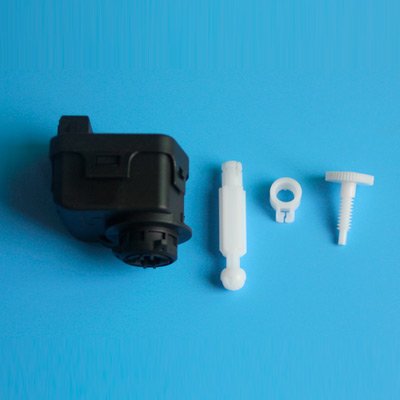
In many small motion-control assemblies, metal gears are selected by default. They are familiar, strong, and widely available.
But metal is not always the best engineering choice.
For applications with moderate torque, controlled operating temperatures, and high production volumes, an injection-molded POM gear can offer a practical alternative. With the right gear design and material selection, manufacturers may reduce part cost by up to 40% while also lowering weight, noise, and assembly complexity.
This article explains when a metal-to-POM gear conversion makes sense, what must be evaluated before changing materials, and how a custom plastic gear supplier can support the process.
The Original Challenge: A Small Metal Gear with High Total Cost
A typical customer application may use a small steel or brass spur gear in a compact drive system.
The metal gear can perform well, but it may also create several cost and production issues:
- CNC machining or hobbing adds processing cost.
- Secondary operations may be required, such as deburring, heat treatment, plating, or oiling.
- Metal parts add weight to the assembly.
- Gear-to-gear contact can create more operating noise.
- High-volume production may require more machining capacity and longer lead times.
For a low-volume or high-load application, these costs may be justified. But for a high-volume device with moderate load requirements, the metal gear may be over-engineered.
Why POM Is Often Considered for Precision Plastic Gears
POM, also known as acetal, is widely used for precision injection-molded gears because it combines good mechanical performance with excellent processability.
Key advantages include:
- Good wear resistance
- Low friction
- Good dimensional stability
- Low moisture absorption compared with many other engineering plastics
- Quiet operation
- Lower part weight
- Efficient production at medium and high volumes
POM gears are commonly considered for office equipment, consumer devices, small appliances, automotive actuators, smart-home products, light-duty automation equipment, and compact motion-control systems.
The Engineering Review Before Replacing Metal
Replacing metal with plastic is not simply a material swap.
A successful conversion requires a review of the complete operating condition. Before recommending POM, engineers should evaluate:
1. Torque and load
The gear must withstand the required transmitted torque, shock load, and duty cycle. Plastic gears are often suitable for moderate-load applications, but they may not be appropriate for extreme torque or impact conditions.
2. Operating temperature
POM performs well in many industrial and consumer applications, but temperature limits must be checked carefully. Continuous high-temperature environments may require another engineering plastic, such as PA66, reinforced nylon, or PEEK.
3. Gear geometry
Tooth profile, module, pressure angle, face width, backlash, and root geometry may need adjustment. A gear designed for metal cannot always be copied directly into plastic.
4. Mating gear material
A POM gear may run against another plastic gear, a metal gear, or a worm. The material pairing affects wear, lubrication needs, noise, and service life.
5. Accuracy requirements
Injection molding can produce highly repeatable gears, but tooling design, shrinkage control, and inspection standards are essential for precision applications.
Where the Cost Reduction Comes From
The cost advantage of a POM gear usually comes from manufacturing efficiency rather than only raw material price.
A machined metal gear may require multiple steps:
- Material cutting
- Gear hobbing or machining
- Deburring
- Heat treatment or surface treatment
- Inspection
- Cleaning and packaging
An injection-molded POM gear can often be produced in a more integrated process once the mold is developed.
For stable, repeat-volume projects, this can reduce:
- Unit machining cost
- Secondary processing
- Material waste
- Assembly weight
- Production cycle time
Depending on the original metal gear design, annual volume, tolerance requirements, and tooling amortization, a conversion to POM may reduce part cost by up to 40%.
The actual result must always be confirmed through drawing review, sample testing, and production-volume analysis.
Additional Benefits Beyond Cost
Cost is usually the first reason to investigate a plastic gear, but it is not the only benefit.
Lower noise
POM has natural damping characteristics that can reduce gear-mesh noise compared with metal-to-metal contact.
Lower weight
Plastic gears can significantly reduce component weight, which is valuable in portable equipment, automotive actuators, and compact robotic systems.
Reduced lubrication needs
In suitable conditions, POM’s low-friction properties can reduce or simplify lubrication requirem