
Small robots are becoming more common in warehouses, laboratories, homes, education, medical devices, and light industrial automation.
Whether it is a compact robotic arm, an autonomous mobile robot, a smart gripper, a service robot, or a small actuator module, many of these systems require reliable motion transmission in a limited space.
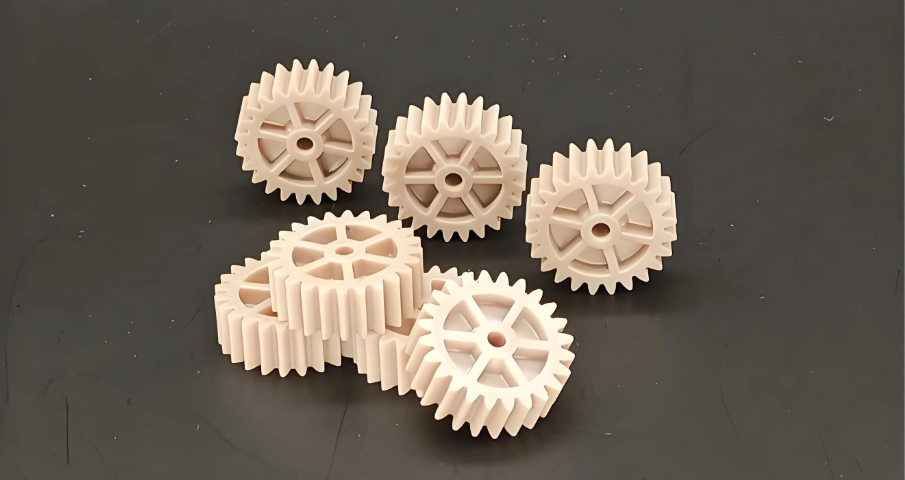
Plastic gears can be an effective solution for small robotics applications when they are properly designed, molded, and matched to the operating conditions.
This article explains why plastic gears are used in robotics, which materials are commonly selected, and what engineers should consider before choosing a custom injection-molded gear.
Why Small Robots Use Plastic Gears
Robotics designers are often balancing several competing requirements:
- Compact size
- Low weight
- Quiet operation
- Stable motion
- Long service life
- Cost control
- Repeatable production quality
A metal gear may be necessary in high-load or high-impact transmission systems. However, for many small robotic mechanisms, a precision plastic gear can provide sufficient performance while offering additional design advantages.
Plastic gears are commonly used in:
- Small robotic arms
- Servo actuator modules
- Robotic grippers
- Mobile robot drive systems
- Smart home robots
- Educational robots
- Laboratory automation equipment
- Compact medical devices
- Camera and sensor positioning mechanisms
Key Benefits of Plastic Gears in Robotics
1. Lower Weight
Weight is a critical factor in robotics.
A lighter gear reduces the total moving mass of the system. This can help improve energy efficiency, reduce motor load, and support faster acceleration and deceleration.
For robotic arms, end-effectors, and mobile platforms, reducing unnecessary weight can improve overall system performance.
2. Lower Operating Noise
Noise reduction is important in service robots, home robots, office equipment, medical devices, and collaborative robotic systems.
Plastic materials such as POM and nylon can provide lower gear-mesh noise than metal-to-metal contact in suitable applications.
The final noise level still depends on gear accuracy, backlash, lubrication, housing design, motor vibration, and assembly quality. However, plastic gears can be a useful part of a low-noise design strategy.
3. Design Flexibility
Injection molding allows engineers to integrate multiple functions into one part.
A custom plastic gear may include:
- A gear and hub
- A gear and shaft interface
- Mounting clips
- Ribs for reinforcement
- Positioning features
- Sensor or encoder interfaces
- Assembly features
Part integration can reduce the number of components, simplify assembly, and lower total system cost.
4. Efficient Production for Volume Projects
For repeat-volume robotic products, injection molding can provide stable and efficient production after the tooling is validated.
Compared with machining individual metal gears, injection molding may reduce unit cost, material waste, and secondary processing requirements.
The economic benefit is usually strongest when the design is stable and annual quantity is sufficient to justify mold investment.
Common Plastic Gear Materials for Robotics
Material selection should be based on load, temperature, wear requirements, chemical exposure, noise targets, and mating gear material.
POM (Acetal)
POM is one of the most common materials for precision plastic gears.
It offers:
- Good wear resistance
- Low friction
- Good dimensional stability
- Low moisture absorption
- Good machinability and moldability
- Quiet operation in many applications
POM is often suitable for small gears, actuator mechanisms, consumer robots, and light-duty automation systems.
PA / Nylon
Nylon is widely used for gears because of its toughness and wear resistance.
It can be a good choice for applications requiring impact resistance and durable performance. However, nylon absorbs more moisture than POM, which may affect dimensions and mechanical properties. This must be considered for precision applications.
Reinforced Nylon
Glass-fiber-reinforced nylon can provide higher stiffness and strength.
It may be considered for higher-load applications, but reinforcement can also affect wear behavior, surface finish, noise, and mating gear selection.
PBT, PPS, and PEEK
For demanding environments, materials such as PBT, PPS, or PEEK may be considered.
These materials can offer improved temperature resistance, chemical resistance, or mechanical performance. They are typically selected when standard POM or nylon cannot meet the operating requirements.
Important Gear Design Considerations
A reliable robotic gear is not determined by material alone.
The complete design should be reviewed before production.
Torque and Duty Cycle
The gear must be evaluated for transmitted
torque, peak load, shock load, start-stop frequency, and continuous operating time.
A robot that moves occasionally has very different requirements from a robot operating continuously on a production line.
Gear Type and Geometry
Spur gears, helical gears, worm gears, bevel gears, and planetary gear components each have different design requirements.
Important factors include:
- Module or diametral pitch
- Number of teeth
- Pressure angle
- Face width
- Tooth profile
- Root geometry
- Backlash
- Center distance
For plastic gears, tooth geometry may need to be optimized for molding shrinkage, load distribution, and wear performance.
Tolerance and Backlash
Robotics often requires stable and repeatable motion.
Too much backlash can reduce positioning accuracy. Too little backlash can increase friction, noise, and wear.
The correct backlash depends on the gear material, operating temperature, housing tolerance, shaft tolerance, and assembly method.
Mating Gear Material
Plastic gears can mesh with plastic, metal, or other engineered materials.
The mating material affects friction, wear, lubrication requirements, noise, and service life. A POM gear running against a metal pinion may require a different design approach than a plastic-to-plastic gear pair.
Mold Design and Shrinkage Control
Precision injection molding requires more than a good CAD drawing.
Tool design, gate location, cooling, material flow, shrinkage compensation, and cavity accuracy all influence the final gear quality.
For custom gears, manufacturability should be reviewed early to avoid unnecessary tooling changes later.
When Plastic Gears May Not Be the Right Choice
Plastic gears are not suitable for every robotic transmission.
Metal gears may remain the better option when the application involves:
- Very high torque
- Severe impact loading
- Continuous high-temperature operation
- High-speed operation with significant heat generation
- Extremely low backlash requirements
- Harsh chemical environments
- Safety-critical load transmission
In some designs, the best solution may be a hybrid system using both metal and plastic gears.
How LiCoom Motion Supports Custom Robotic Gear Projects
LiCoom Motion provides custom precision plastic gears for motion-control and automation applications.
We can support your project from early-stage drawing review to sampling and mass production.
Our engineering team can help evaluate:
- Gear type and tooth geometry
- Material selection
- Injection molding feasibility
- Tolerance requirements
- Shrinkage and tooling considerations
- Mating gear compatibility
- Prototype and production planning
If you are developing a small robotic mechanism and need a custom plastic gear, send us your 2D drawing, 3D model, material requirement, annual quantity, and operating conditions.
We will review the design and provide practical feedback for manufacturing and cost optimization.
Request a Custom Plastic Gear Review
Looking for a plastic gear manufacturer for your robotics project?
Contact LiCoom Motion with your drawings and application details. We support custom injection-molded gears for robotics, automation equipment, motion-control modules, and compact mechanical assemblies.