
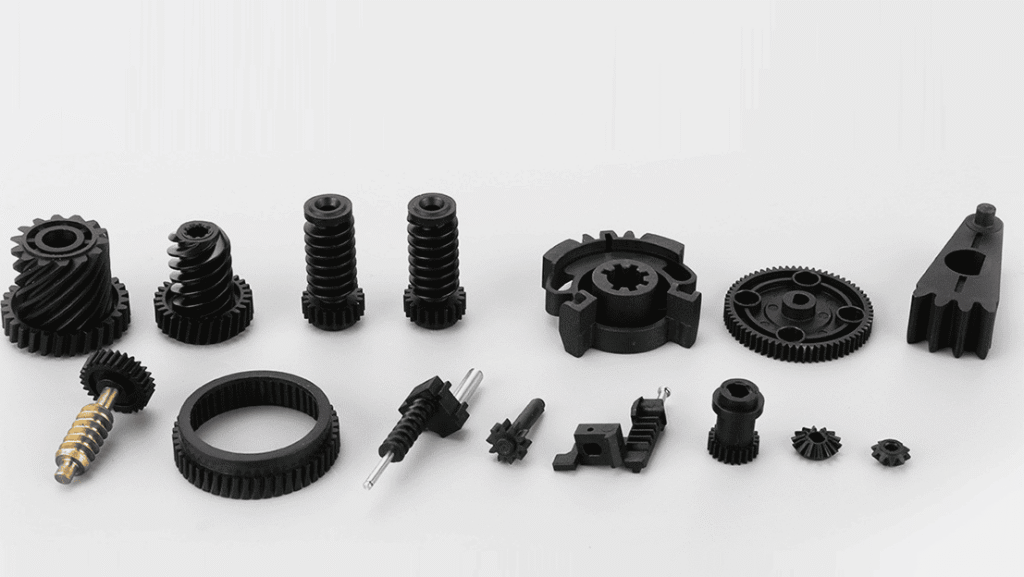
Why Plastic Gear Design Matters
Plastic gears have become an essential component in modern motion systems. Compared with traditional metal gears, engineered plastic gears offer significant advantages including lower weight, quieter operation, corrosion resistance, and lower manufacturing costs.
Today, industries such as robotics, medical equipment, consumer electronics, automotive actuators, and smart home devices increasingly rely on precision plastic gears for reliable power transmission.
However, successful plastic gear performance begins long before manufacturing—it starts with proper gear design.
This guide explains the key engineering considerations when designing custom plastic gears for high-performance applications.
Step 1. Choose the Right Plastic Material
Material selection is the most important decision in plastic gear design.
Different engineering plastics provide different combinations of strength, wear resistance, dimensional stability, and chemical resistance.
POM (Acetal)
POM is the most commonly used plastic gear material because it offers:
- Low friction
- Excellent wear resistance
- High dimensional stability
- Low moisture absorption
- Quiet operation
Typical applications:
- Office automation
- Robotics
- Medical equipment
- Small gearboxes
PA66 (Nylon)
PA66 provides higher toughness than POM.
Advantages include:
- High impact strength
- Excellent fatigue resistance
- Good load capacity
Limitations:
- Higher water absorption
- Reduced dimensional stability in humid environments
Applications include industrial machinery and power transmission systems.
PEEK
PEEK is used in demanding environments where gears operate under:
- High temperatures
- Chemical exposure
- Continuous heavy loads
Industries include:
- Aerospace
- Medical
- Semiconductor equipment
Although expensive, PEEK offers outstanding long-term reliability.
Step 2. Select the Proper Gear Type
Choosing the correct gear geometry depends on the application.
Spur Gears
Best for:
- Simple transmission
- Low manufacturing cost
- High efficiency
Common in consumer products and automation.
Helical Gears
Advantages:
- Lower noise
- Smoother engagement
- Higher load capacity
Ideal for precision equipment.
Worm Gears
Provide:
- High reduction ratios
- Self-locking capability
Often used in positioning systems.
Bevel Gears
Used when motion must change direction between intersecting shafts.
Step 3. Optimize Gear Tooth Geometry
Proper tooth geometry determines:
- Gear efficiency
- Noise
- Wear life
- Load distribution
Critical design parameters include:
- Module
- Pressure angle
- Number of teeth
- Face width
- Backlash
- Root fillet radius
For injection molded gears, engineers should also consider shrinkage compensation during mold design.
Step 4. Design for Injection Molding
Unlike metal gears, plastic gears are usually produced by precision injection molding.
Good mold-friendly designs improve both quality and production efficiency.
Design recommendations include:
- Maintain uniform wall thickness
- Avoid unnecessary thick sections
- Add appropriate draft angles
- Minimize sink marks
- Optimize gate location
- Control cooling to reduce warpage
Well-designed molds improve dimensional consistency and reduce manufacturing costs.
Step 5. Control Tolerances
Precision gears require tight dimensional control.
Important inspection items include:
- Pitch diameter
- Tooth profile
- Runout
- Concentricity
- Bore tolerance
Modern manufacturers use precision CNC machining, gear measuring equipment, and CMM inspection to verify critical dimensions.
Step 6. Consider Operating Conditions
Engineers should evaluate the complete working environment before finalizing the design.
Key factors include:
- Torque
- Speed
- Temperature
- Lubrication
- Humidity
- Chemical exposure
- Duty cycle
These conditions directly influence material selection and expected service life.
Common Plastic Gear Applications
Precision plastic gears are widely used in:
- Industrial automation
- Robotics
- Medical devices
- Smart home systems
- Automotive actuators
- Office equipment
- Consumer electronics
- Electric tools
- Laboratory instruments
The trend toward lightweight, quiet, and maintenance-free transmission systems continues to increase demand for engineered plastic gears.
Why Work with an Experienced Plastic Gear Manufacturer
A reliable manufacturing partner should provide more than molding services.
Look for suppliers that offer:
- Engineering support
- Material selection assistance
- Mold design optimization
- Prototype development
- Precision injection molding
- Dimensional inspection
- Small and large production runs
Early engineering collaboration often reduces development time while improving gear performance.
Conclusion
Designing high-performance plastic gears requires balancing material selection, gear geometry, manufacturing methods, and operating conditions.
Whether developing a robotic transmission system, medical device, or precision actuator, thoughtful engineering at the design stage leads to longer service life, lower noise, and improved product reliability.
At Licoom Motion, we specialize in custom precision plastic gears, engineering support, injection mold tooling, and high-volume manufacturing for OEM customers worldwide.
Contact our engineering team to discuss your next plastic gear project.