
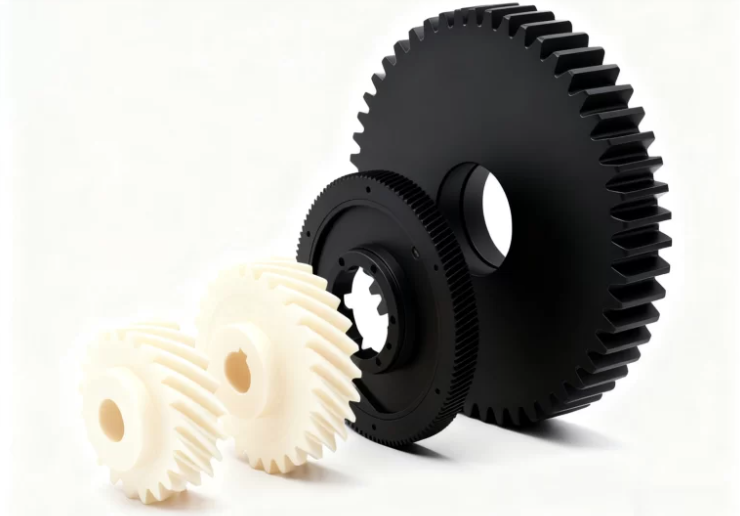
In modern motion control systems, design engineers are increasingly replacing traditional metal gears with high-performance engineering plastics like POM (Acetal), PEEK, and Nylon. Plastic gears offer undeniable advantages: they are lightweight, self-lubricating, corrosion-resistant, and highly cost-effective for mass production through precision injection molding.
However, once you decide to go plastic, you face a fundamental design question: Should you use plastic spur gears or plastic helical gears?
Choosing the wrong gear type can lead to excessive noise, premature wear, or system failure. In this guide, we will break down the technical differences, pros and cons, and application scenarios for both to help you make the right choice for your next project.
1. What are Plastic Spur Gears?
Plastic spur gears are the most common and simplest type of gear. They have straight teeth that are cut or molded parallel to the rotation axis.
The Advantages:
- High Efficiency: Because the teeth mesh directly without sliding along the axial direction, spur gears offer excellent power transmission efficiency.
- No Axial Thrust: Spur gears only generate radial loads. This means you do not need to design complex, expensive bearing arrangements to handle thrust forces.
- Cost-Effective Tooling: The mold design for injection-molded spur gears is straightforward, resulting in lower tooling costs and faster time-to-market.
The Disadvantages:
- Noise at High Speeds: When spur gears mesh, the entire face of one tooth contacts the entire face of another instantly. This line contact creates a “clicking” or “slapping” sound, which can lead to high noise and vibration at elevated RPMs.
2. What are Plastic Helical Gears?
Plastic helical gears have teeth that are cut or molded at an angle (the helix angle) to the gear axis.
The Advantages:
- Ultra-Quiet and Smooth Operation: Unlike spur gears, the teeth of a helical gear engage gradually. The contact starts at one end of the tooth and rolls smoothly to the other. This significantly reduces noise and vibration, making them ideal for high-speed applications.
- Higher Load Capacity: Because the teeth are angled, they are physically longer than spur gear teeth of the same width. Multiple teeth are engaged at any given time, distributing the load and allowing the gear to carry higher torque.
The Disadvantages:
- Axial Thrust Load: The angled teeth introduce an axial force (thrust load) along the shaft. Your system design must include appropriate bearings (such as thrust bearings) or use a double-helical configuration to counteract this force.
- Complex Manufacturing: Injection molding plastic helical gears is more complex. The mold core must rotate as the part is ejected to prevent stripping the teeth, requiring highly precise tooling design.
3. Head-to-Head Comparison
To help your engineering team quickly evaluate the trade-offs, here is a direct comparison:
| Feature | Plastic Spur Gears | Plastic Helical Gears |
| Tooth Alignment | Parallel to the shaft axis | Angled (Helix angle) to the axis |
| Noise & Vibration | Moderate to High (at high speeds) | Extremely Low (Smooth & Quiet) |
| Load-Carrying Capacity | Standard | Higher (More tooth engagement) |
| Axial Forces Generated | None | Yes (Requires thrust management) |
| Tooling & Production Cost | Lower / Standard | Higher (Complex rotational ejection) |
4. Application Guide: When to Choose Which?
Choose Plastic Spur Gears If:
- Budget is a priority: Your project requires a cost-effective solution with standard manufacturing tolerances.
- Space or weight constraints prevent thrust bearings: You want a simple mechanical layout without worrying about axial forces.
- Low-speed operation: The system operates at lower RPMs where gear noise is not a critical factor (e.g., standard micro-pumps, basic conveyor drives, or toys).
Choose Plastic Helical Gears If:
- Noise reduction is critical: You are designing for industries where quiet performance is a key selling point, such as medical devices, smart home automation, or high-end consumer electronics.
- High-speed or high-torque applications: The gears need to handle higher mechanical stress smoothly without wearing out prematurely (e.g., automotive actuators, precision office automation, and robotics).
Conclusion: Partner with a Precision Plastic Gear Expert
There is no single “best” gear—only the gear that perfectly matches your application’s requirements, torque demands, and budget. When working with high-performance polymers, understanding mold shrinkage and gate placement is just as important as choosing between spur and helical profiles.
At liCoom-Motion, we specialize in precision plastic gear manufacturing and motion control solutions. Whether you need custom spur gears for high efficiency or ultra-quiet helical gears for medical applications, our engineering team is here to optimize your design.
Ready to optimize your motion control system? [Contact liCoom-Motion today] for a professional Design for Manufacturing (DFM) review and a custom quote!