
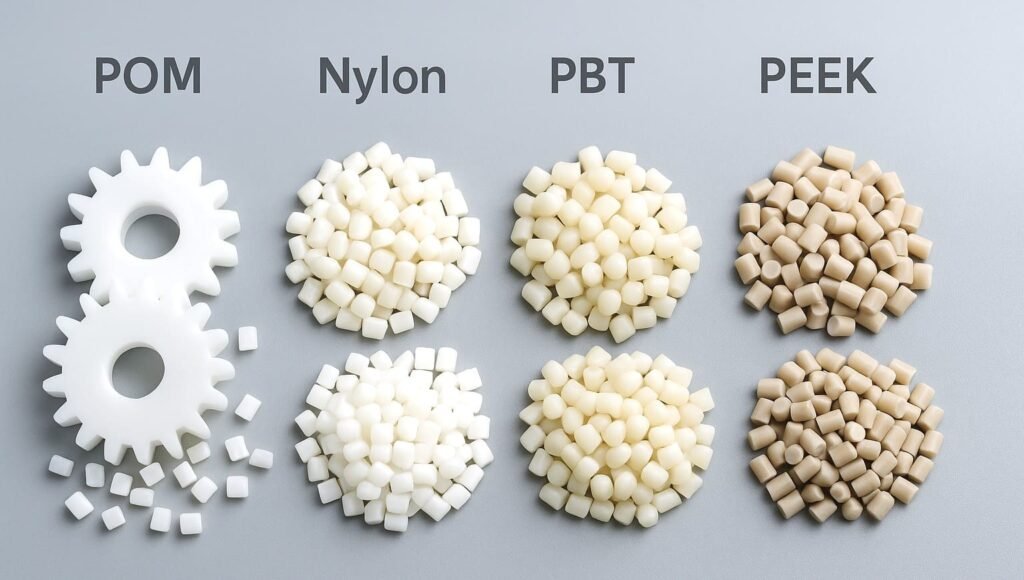
Choosing between POM and Nylon for plastic gears? This guide compares strength, friction, moisture resistance and cost to help engineers choose the right material.
When selecting materials for precision plastic gears, two names come up most often: POM (Polyoxymethylene, also known as Acetal or Delrin) and Nylon (Polyamide, PA6 or PA66). Both are widely used in gear manufacturing, but they perform very differently depending on the application.
This guide breaks down the key differences so you can make the right choice for your project.
What is POM?
POM is a high-stiffness engineering plastic known for its excellent dimensional stability, low friction, and resistance to moisture. It is one of the most popular materials for small precision gears.
Key advantages of POM gears:
Very low moisture absorption (less than 0.2%), so dimensions stay stable in humid environments
High surface hardness and wear resistance
Naturally low coefficient of friction — ideal for dry-running gear pairs
Excellent machinability and moldability for tight tolerances
Good chemical resistance to fuels, solvents, and oils
Limitations of POM:
Lower impact resistance compared to Nylon
Less suitable for high-temperature environments (softens above 100°C)
Bonds poorly with adhesives
What is Nylon?
Nylon (PA6 / PA66) is a tough, flexible engineering plastic with high impact strength. It is widely used in automotive and industrial gears where shock loads are common.
Key advantages of Nylon gears:
High impact and fatigue resistance
Better performance at elevated temperatures (up to 120–150°C)
Good noise damping properties
Can be reinforced with glass fiber for higher strength
Lower material cost compared to POM in many cases
Limitations of Nylon:
Absorbs moisture significantly (up to 8%), which can cause dimensional changes
Requires careful design allowances for swelling in humid or wet environments
Higher friction coefficient than POM in dry conditions
Head-to-Head Comparison
PropertyPOMNylon (PA66)Moisture AbsorptionVery Low (0.2%)High (up to 8%)Dimensional StabilityExcellentModerateFriction (dry running)LowModerateImpact ResistanceModerateHighTemperature RangeUp to 100°CUp to 150°CCostModerateLowerNoise DampingGoodBetter
Which Should You Choose?
Choose POM when:
Dimensional precision is critical
The environment is humid or wet
Dry-running with minimal lubrication is required
You need tight tolerances maintained over time (e.g. automotive actuators, medical devices)
Choose Nylon when:
The application involves shock loads or vibration
Higher operating temperatures are expected
Cost reduction is a priority
Noise reduction is important (e.g. home appliances, power tools)
Our Recommendation
At LiCoom Motion, we work with both POM and Nylon — as well as PC, PBT, and glass-filled variants — to match the exact requirements of each application. Our engineering team can advise on material selection based on your load, speed, environment, and lifetime requirements.
Contact us today to discuss your gear material needs and request a sample or quotation.